Curatorial Statement
Shakespeare's The Merchant of Venice, directed by Strahinja Padežanin, is set in Venice in 1938, at a time when Italy's fascist racial laws had transformed Jewish identity from a matter of faith and origin into a legal status determining an individual's position within society. The performance opens with a reading of Mussolini's “Measures for the Defence of the Italian Race,” establishing the historical framework before the story of Shylock, Antonio and the pound of flesh unfolds.
Within this framework, Shylock is not merely an individual subjected to prejudice. His position is determined by the community to which he belongs, yet which simultaneously refuses to grant him full belonging. Padežanin does not present him either as a completely innocent victim or as a straightforward villain. When Shylock demands a pound of flesh, the demand remains brutal, but the performance first raises the question of how a person is brought to the point where the law becomes the place from which he can strike back.
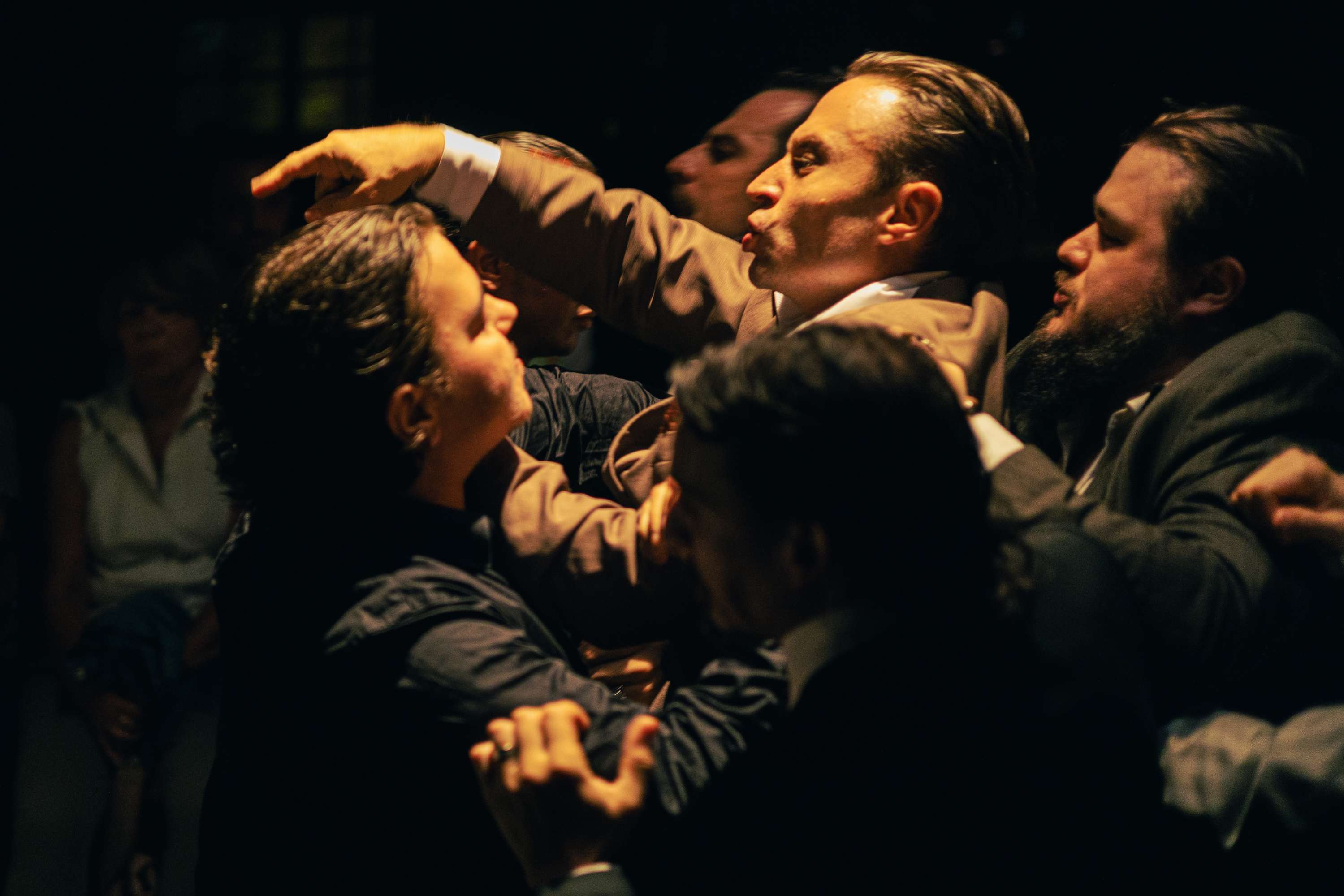
Padežanin uses the space of the Stara Šećerana in such a way that the boundary between performers and audience becomes less distinct. The enclosed, compressed performance space intensifies the sense of pressure exerted by the community and the crowd. The historical framework is therefore not merely a reconstruction of a particular period: Shakespeare's story is brought into relation with the experience of a society in which difference is first marked and then turned into grounds for exclusion.
At the centre of the performance is Slobodan Beštić as Shylock. His interpretation does not reduce the character to a single quality: his desire for revenge grows out of an experience of humiliation, but that does not absolve him of responsibility for his actions. The KPGT ensemble simultaneously creates the community whose behaviour determines the space in which Shylock moves. The soundscape, with Eldar Zubčević's rhythmic drumbeats, further establishes a sense of pressure and tension.
In this production, the question is not only what Shylock is prepared to do, but also what kind of relationship between a community and an individual makes such a conflict possible.
About the Performance
Even Shakespeare, as he’s writing The Merchant of Venice as a comedy, doesn’t seem to believe either in the equality of all people - the Christians and Jews and everybody else, or in the possibility that the victim might become the aggressor. However, when in the reality the roles reverse, the comedy dissipates, and the play changes its genre. Then, every line of this drama cuts like a knife through its pound of flesh. The fate becomes a trial with an outcome impossible to predict. Shylock’s line: “The villainy you teach me I will execute, and it shall go hard but I will better the instruction” no longer sounds like an empty threat, but as a prophecy announced, one that will set a stage for the tragedy that is to come, or that is already here, all around us.