There are moments when it seems that we already have the answers. Everything has been explained, sides have been assigned, it is clear who is right, who is guilty, and what one is supposed to think about it all. All that remains is to fall in line.
Theatre is one of the places where such certainty can be called into question. At times, it forces us to look once again at a person who has already been judged, an event we believe we understand, or a conviction that until then seemed firm. Hence the title of this year's Bitef: “Dare to Find Out.” Not “dare to know” - because finding out requires a willingness to question even what we thought we were certain about.
The selection took shape at a time when the very holding of the festival had become a subject of public and political debate. For this reason, the selection does not proceed from a predetermined theme, aesthetic or position. What connects these different performances above all is their willingness not to replace the complexity of the world with a simple answer or a ready-made explanation.
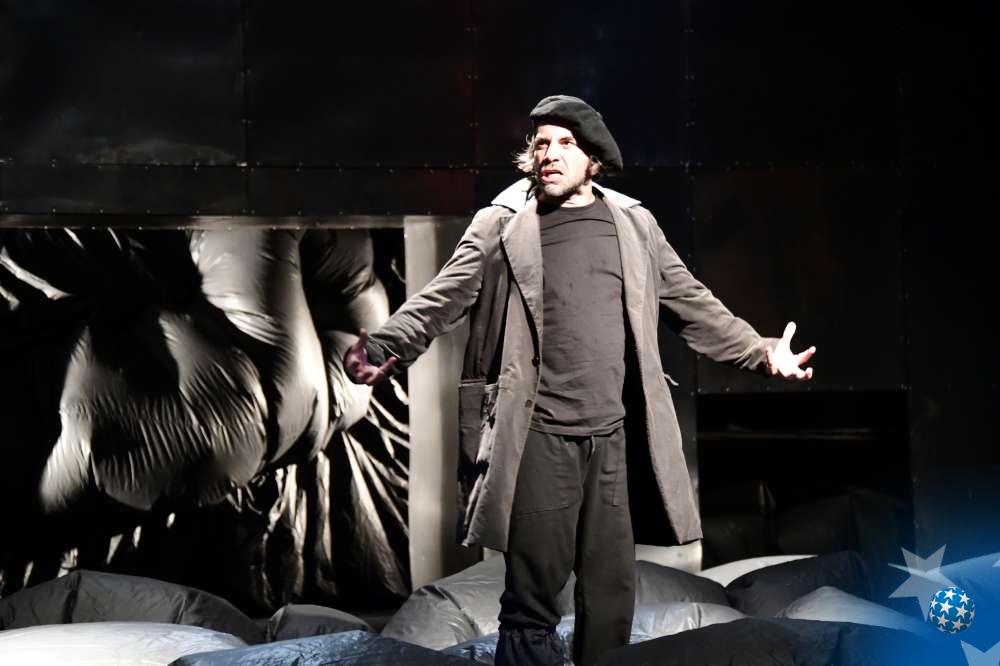
Shakespeare's The Merchant of Venice, produced by KPGT (Serbia) and directed by Strahinja Padežanin, sets the action in Venice in 1938, at a moment when the Fascist regime in Italy was stripping Jews of citizenship, the right to public employment and the right to enter into mixed marriages through its racial laws - all in the name of a homogeneity that the regime presented as a defence of the nation. But the production is not only about history. It is about how an enemy is made. Shylock is a stranger within the community to which he belongs. His difference is not merely a fact of his origin and faith. It becomes the reason why the majority can humiliate, set apart and define him. And then, when he strikes back, society is confronted with the consequences of its own violence. It is not difficult to condemn a man who demands a pound of flesh. It is much harder to look at the world in which such a demand became possible.
Albion by Mike Bartlett, directed by Zafir Radjab and produced by the Youth Theatre from Sofia (Bulgaria), raises a different question. The protagonist attempts to restore the family garden as a memorial to her son, whom she lost in the war, and with it a world that once belonged to her. Radjab reads the play as a study of nostalgia - not as a feeling, but as a social mechanism. What does it mean to try to restore what has passed, and what happens when the desire to return, rooted in private memory, grows into a broader social need? An attempt to restore the past therefore means not only returning to one's own memories, but also confronting those who do not remember that past in the same way.
Chisinau by Night by Mihai Fusu, produced by the Teatrul Fără Nume - Nameless Theatre in Chisinau (Moldova), is a documentary performance based on the real stories of the city's inhabitants - taxi drivers, receptionists, doctors, nightclub workers, dancers, former addicts… Fusu creates a performance in which the boundary between documentary and theatre is constantly shifting. The city is not merely a backdrop, but a dramatic character - not the city of postcards, but the one that exists after the lights go out. One life leads into another, one experience opens onto the next, and Chisinau appears before us as a multitude of different cities, as a society that has no single version of itself.
In Stalker by Avtandil Varsimashvili, produced by the Liberty Theatre (Georgia), the journey leads into an entirely different space. The production takes Andrei Tarkovsky's film of the same name as its starting point, but is not its illustration; it is an independent theatrical exploration. The Writer, the Professor and the Stalker enter the Zone, a place where, according to legend, there is a room capable of fulfilling a person's deepest desire. Varsimashvili uses Tarkovsky's world as a starting point for reflecting on faith, doubt and the limits of human knowledge, at a time when the boundaries between truth and falsehood have become increasingly difficult to discern. The Zone thus becomes a space in which the question of desire turns into a question about the person who carries that desire.
Black Gold by Dejan Dukovski, directed by Oliver Frljić and performed by the ensemble of the Belgrade Drama Theatre (Serbia), opens up the space of the family. But the family is not a place of safety here either. The son who was believed to be lost returns as a successful woman, and that return changes the relationships between the family members and their understanding of their own past. Frljić calls this mechanism “tragic ignorance.” The characters do not know what they are doing, and their decisions produce consequences they cannot foresee. The political does not take place here only in the streets and in parliament, but also at the kitchen table, in the words that are spoken and those that remain unspoken. Identity is not something fixed and determined once and for all. A person is what they remember about themselves, but also what others remember about them. Those two memories do not necessarily coincide. When the truth finally emerges, it does not necessarily bring relief. Some truths merely reveal how long we have lived without them.
Sophocles' Antigone, produced by Karma Sahne of Samsun (Turkey) and directed by Hakan Alkan, returns us to one of the oldest conflicts in European theatre: the individual against the law, conscience against command, the family against the state. Antigone believes she is acting rightly. Creon believes he is defending order. Each sees only part of the truth, and neither is any longer willing to hear the other - hence the tragedy. Alkan places this ancient tragedy in a space where the question of law directly confronts the question of individual responsibility. If one side were entirely right and the other completely wrong, perhaps we would not have tragedy. We would have a verdict. And theatre is not a courtroom. Antigone therefore raises not only the question of the limits of law, but also the limits of our conviction that we are right.
The Runaways by Wafa Taboubi, produced by the Tunisian National Theatre (Tunisia), is a performance about people who wait - wait to escape, wait for something to change, wait for life to move forward. But waiting here is not a void between two events. It becomes the event itself. In this way, waiting grows into a new kind of prison. Taboubi does not name the political circumstances, but shows them through bodies struggling to endure, through breathing that becomes increasingly difficult, through movements that are at once attempts to escape and signs that there is still no way out. Freedom here is not a destination one reaches, but a possibility that is constantly postponed.
As part of the side program, Russian Blues by Sofia Gorlova and Anton Shmakov explores the encounter between different individualities and the possibility of finding intimacy, freedom, and a sense of belonging within a shared space. Drawing on the experience of Russia and the Urals, the performance transforms these questions into a universal story about our relationship with the other and the search for a place we can call home.
As in previous years, this edition will also feature Meeting the Authors, a traditional side program held after the performances, giving audiences the opportunity to learn more about the productions in both the main and side program directly from the artists themselves.
None of these performances exists outside the world in which it is presented. Wars, migration, technological change and economic uncertainty are transforming the everyday experience of large numbers of people, while the boundaries between private and public, individual and political, are becoming increasingly unstable. What appears to be a shared problem often turns out to be a series of different personal experiences and interests. Trust in shared authorities is weakening, while public discourse is increasingly giving way to alignment with one side or another and to conclusions reached in advance.
In Serbia, recent years have been marked by a sharp decline in trust in institutions - from the state to the media and cultural institutions. This erosion has many causes, but its consequence is clearly visible: different parts of the same society now describe the same reality as though they lived in different countries, spoke different languages and shared different memories - as though knowing who said something were enough to know whether it was true.
Theatre is not separate from these processes, nor does it possess any special authority or solutions that other areas have failed to find. What it does retain, however, is the fact that a performance brings people together in the same place, at the same time, in an experience that cannot be stopped, accelerated or rewound. That alone does not create consensus, but it still makes a shared experience possible.
Opinions on whether the festival should take place at such a moment differ. Bitef does not resolve that disagreement, nor should it. Its place is where different views can meet.
Spasoje Ž. Milovanović, Theatrologist